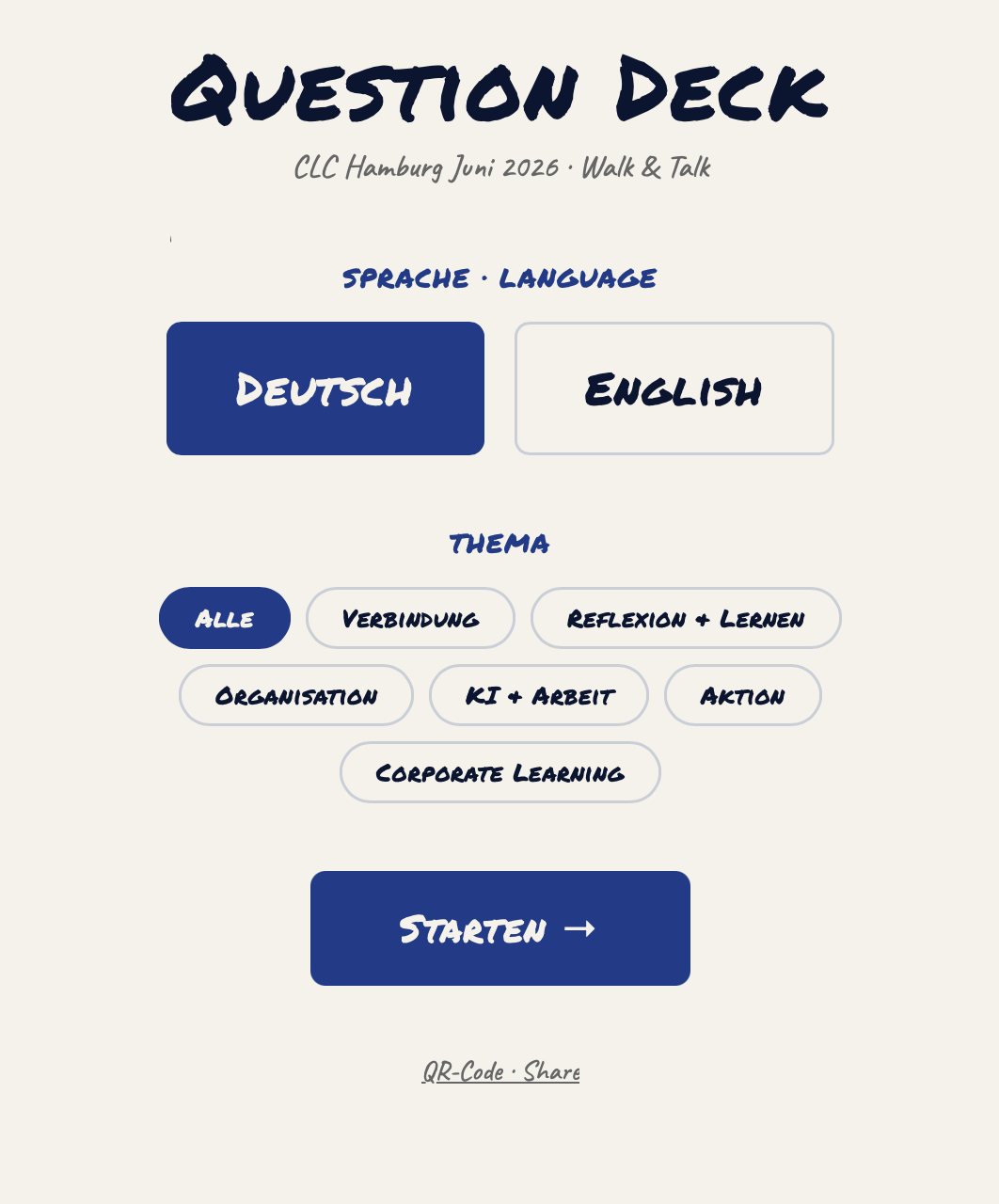
Question Deck
Question cards to get conversations going, built for the Corporate Learning Community Hamburg. The idea behind it: groups work better once they have talked to each other. Connection comes before content.
Your team uses AI. Who checks the sources? Who judges the results? I show teams in companies, educational institutions and newsrooms how to build AI into their work without blindly trusting the output. My craft comes from journalism: checking sources.
Yvonne Pöppelbaum
Journalism-grounded teaching for AI-assisted research and AI literacy
If you want to use it, you have to steer it with care. That's why my work starts before the tools: with the tasks your team actually has. What AI can do belongs in the training. So does what it can't. Judgement stays with people.
The EU AI Act requires companies and organisations that use AI to promote AI literacy among their staff (Art. 4). I build the workshops around your team's actual tasks: what AI can do, where it fails, how to check its results and what data protection and regulation require. In German or English, on site or online.
Half a day to several days: newsrooms, research teams and educational institutions work on their own research tasks and learn how to check sources, spot hallucinations and document evidence properly.
Blended learning programmes running over several months: webinars, assignments between sessions, live sessions. I build the arc from needs analysis to evaluation.
Workshops, webinars, community formats. I shape the space so that groups with different levels of prior knowledge get down to work.
My reference points come from newsrooms: pressure to get the facts right, deadline pressure, healthy scepticism about AI. That's exactly where my teaching starts.
“Before, our team only used AI as a better search engine. Now we know how to use it in a structured way: check first, then let it work, then review. You can clearly tell there is a solid method and journalistic accuracy behind it. Since then, we have been working together noticeably more systematically as a team. We will definitely come back to Yvonne as soon as we're ready for the next step. Highly recommended.”
Between the steps, a person makes the call.
Let AI produce straight away and you get plausible text full of gaps. That's why I work in four steps: analyse first, then check and decide, then produce, then test against criteria. This sequence is part of every training I run. And of this website: it was made exactly this way.
I build small tools, each carrying one learning idea. Have a go.
Question cards to get conversations going, built for the Corporate Learning Community Hamburg. The idea behind it: groups work better once they have talked to each other. Connection comes before content.
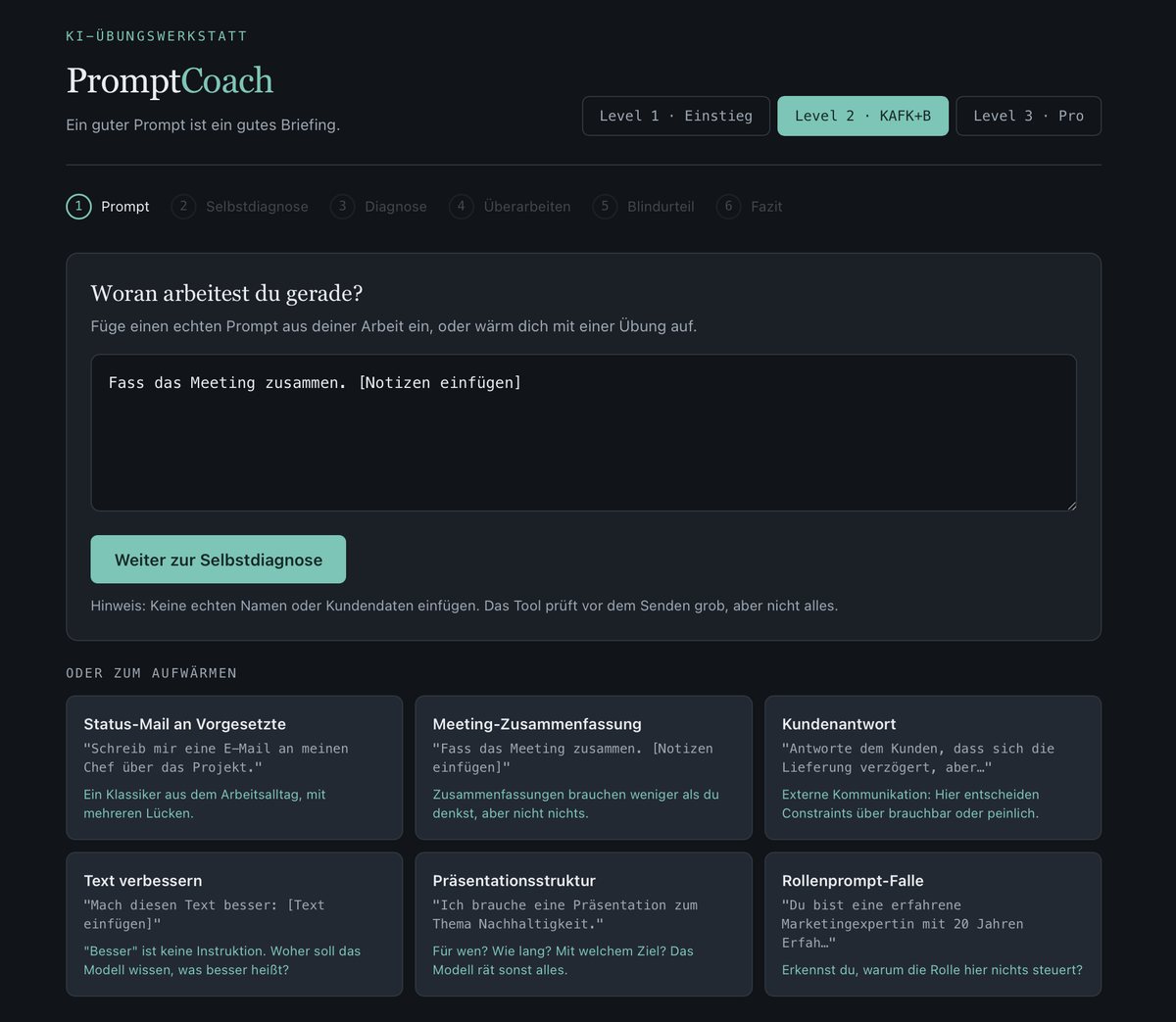
A practice workshop for prompts. I enter a prompt, the tool shows the gaps against a fixed framework and I rework them. At the end I compare both results blind and decide for myself which one works better.
→ Try it In German. Calls Claude live. You'll need to sign in briefly to use it.
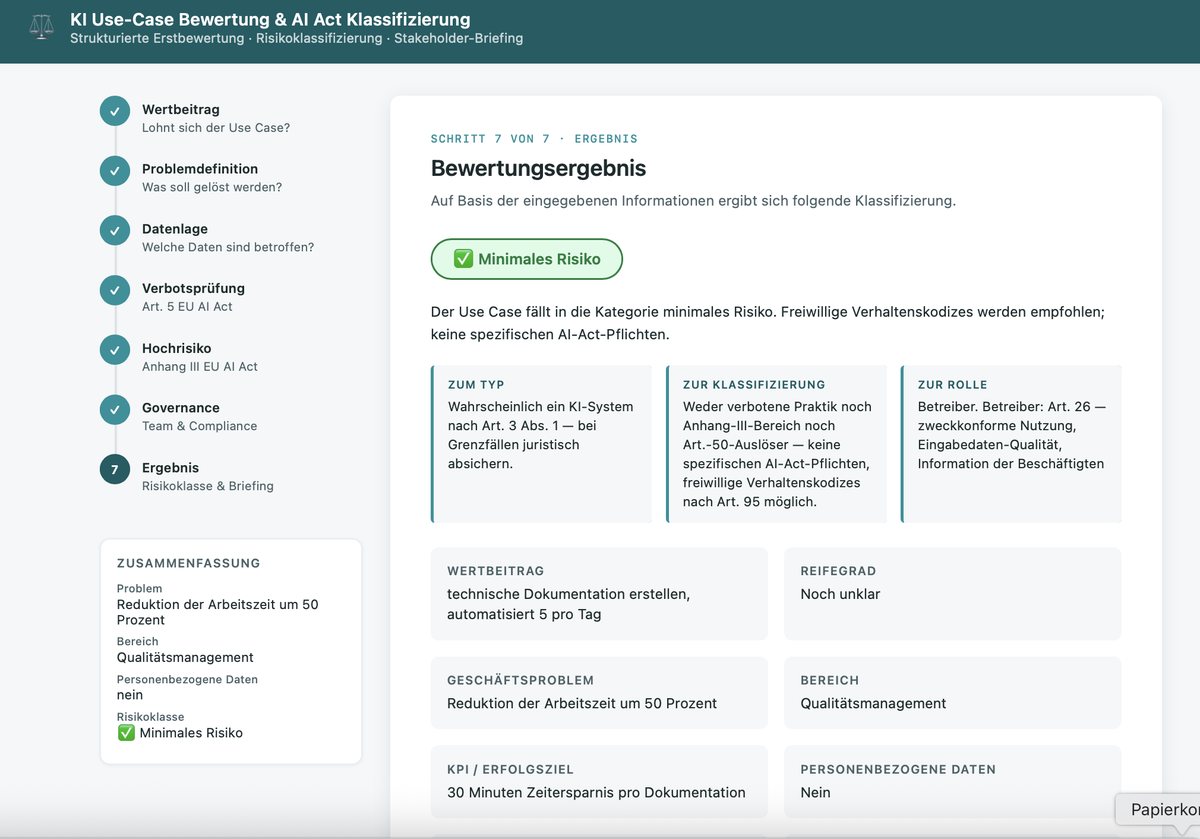
I describe an AI project in seven steps. The tool places it in the risk categories of the EU AI Act and turns it into a briefing for stakeholders. The idea behind it: classify first, then build. Judgement stays with people.
→ Try it In German.
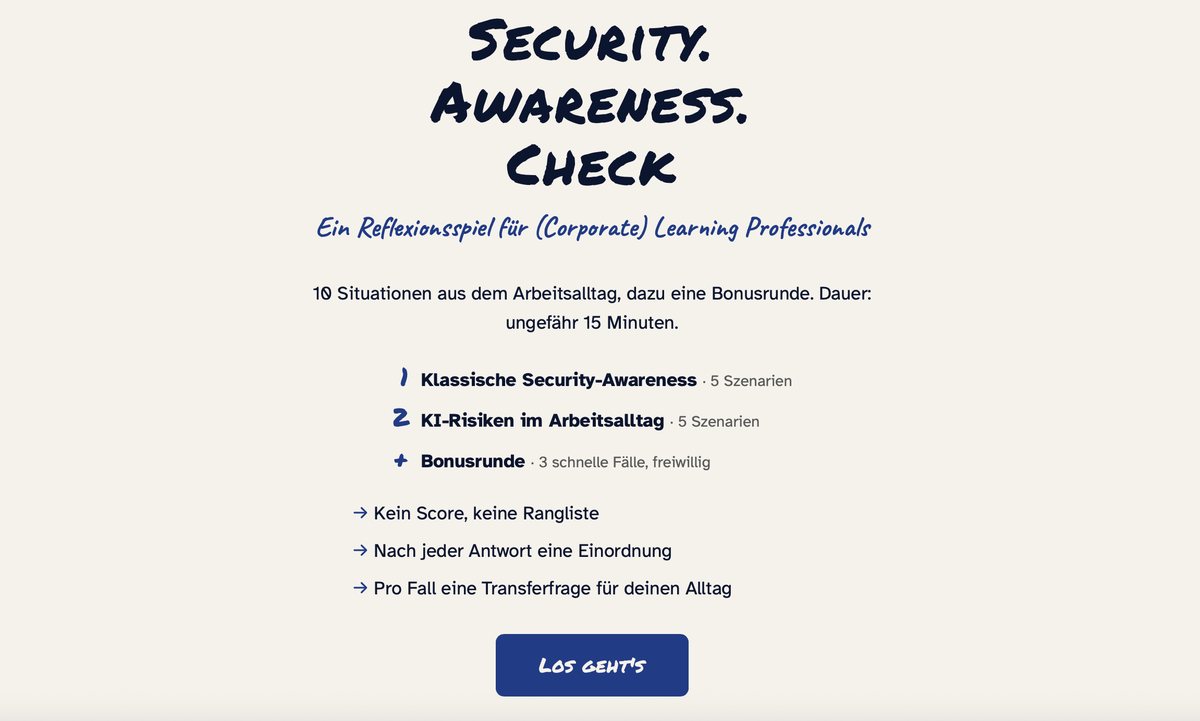
A reflection game: 13 situations from everyday work, from phishing to AI risks. No score, no leaderboard. After each answer you get some context and a question to carry into your own working day. The guiding idea: AI works. People judge.
→ Try it In German.
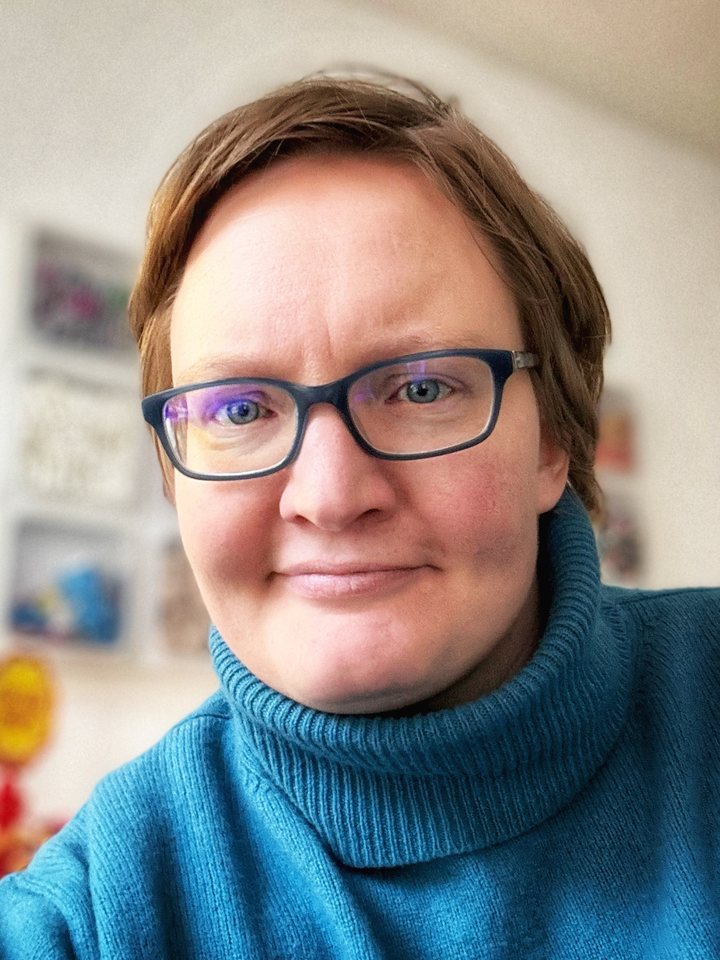
I help people without a tech background use AI in their everyday work. Trained journalist and experienced developer of learning programmes, workshops, AI maker days and blended learning formats. Co-lead of the Corporate Learning Community's Hamburg region. Completed in 2026: full-time training as an Agile AI Manager (DEKRA/WBS) & AI DONE RIGHT (Barbara Lampl). I like automation, I'm interested in security awareness facilitation and I keep looking for smart solutions. Since 2026, as YP Learning Design for AI Adoption, I have been supporting teams with AI adoption and agile transformation. Topics: AI for research, security awareness for journalists, advanced prompting, Claude Code and GitHub.
Security awareness facilitation with a simulation game: four special units, one hijacked account, one countdown. Plus a look behind the scenes at how the material was made with Claude. In German.
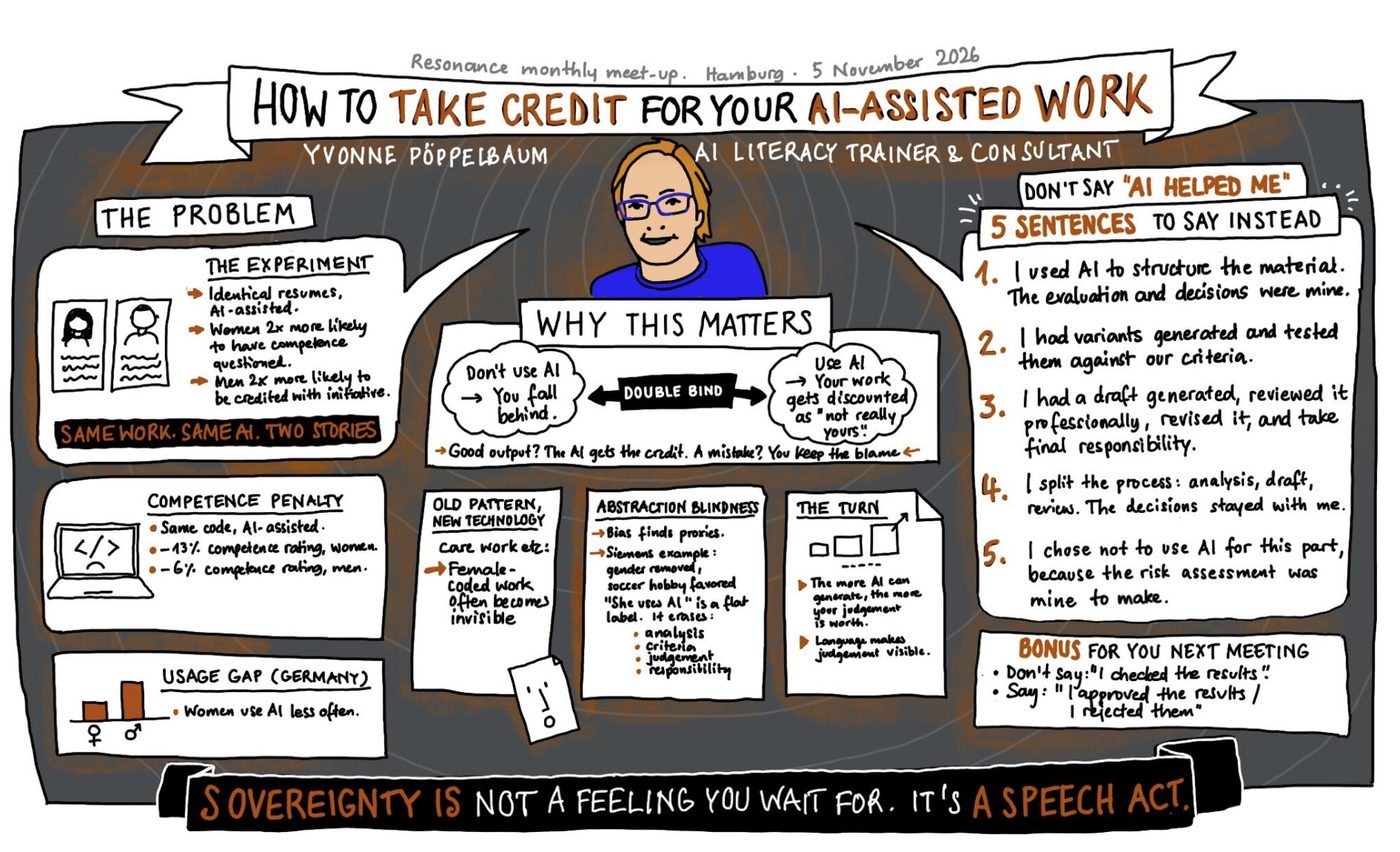
Talk “Take Credit for Your AI-Assisted Work”.
Workshops for students and teachers: „Sicher im Alltag mit KI – Kompaktkurs für Lehrkräfte“ (“Safe everyday use of AI: a compact course for teachers”), „Der Anruf: Cyberangriff als Planspiel“ (“The call: a cyberattack simulation game”) and „Phishing-Detektive“ (“Phishing detectives”), also a simulation game. In German.
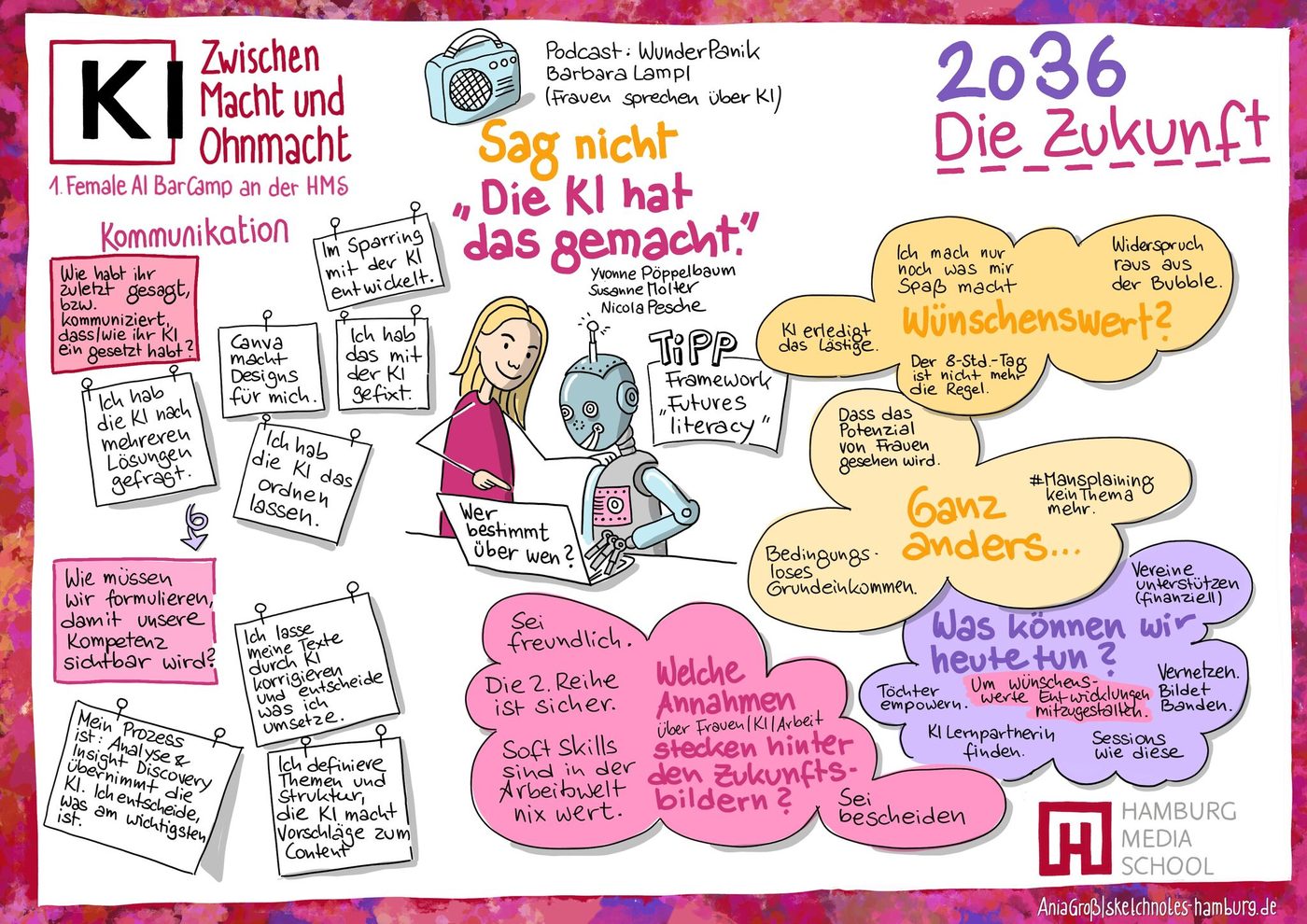
Session „Sag nicht ‚Die KI hat das gemacht‘“ (“Don't say ‘the AI did it’”) with Susanne Molter and Nicola Peschke: how do we phrase things so that our expertise shows? In German.
Mentor at the largest AI hackathon for women in Germany (according to AI.Women), with 300 participants (GitHub, Claude Code, prompting, product development)
AI enablement focused on Claude Projects for the team of the Chair of Media Studies.
Organisations I have worked for as a freelancer in recent years: Weltreporter (co-management), Goethe-Institut, FES Medienakademie, University of Tübingen, Lie Detectors, Spotlight Verlag (now ZEIT Sprachen), managerSeminare, Unicum Verlag, telc, Münchner Stadtbibliothek (Munich City Library) and Rautenstrauch-Joest-Museum Cologne. Most recently I was employed by tactile.news in Lüneburg (workshops and consulting) and by Freischreiber (co-management).
| Year | Certificate | Issued by |
|---|---|---|
| 2026 | AI DONE RIGHT | Barbara Lampl |
| 2026 | DEKRA Agile KI-Manager*in (Agile AI Manager; incl. AI governance, EU AI Act, ISO 42001, AI risk, PSM I and PAL I) | WBS Training / DEKRA / Scrum.org |
| 2026 | Advanced Prompt Engineering for Journalists | Knight Center for Journalism in the Americas (Joe Amditis) |
| 2025 | AI & Learning Design Bootcamp – FRAME™ methodology | Maven / Dr Philippa Hardman |
| 2024/2025 | Designing & Facilitating Learning Spaces I + II | KAOSPILOT |
| 2024 | Generative AI for Media Professionals Masterclass | Maven (Jeremy Caplan & Nikita Roy) |
| 2019 | Train-the-Trainer | Reporter-Akademie, Berlin |
Tell me what your team is working on right now. I'll reply with a concrete proposal.
info@poeppelbaum.eu